Yield farming on Curve, step by step
Providing liquidity is only half the job. Rewards accrue through gauges, and how much you receive depends on your veCRV boost, gas costs and how often you compound.
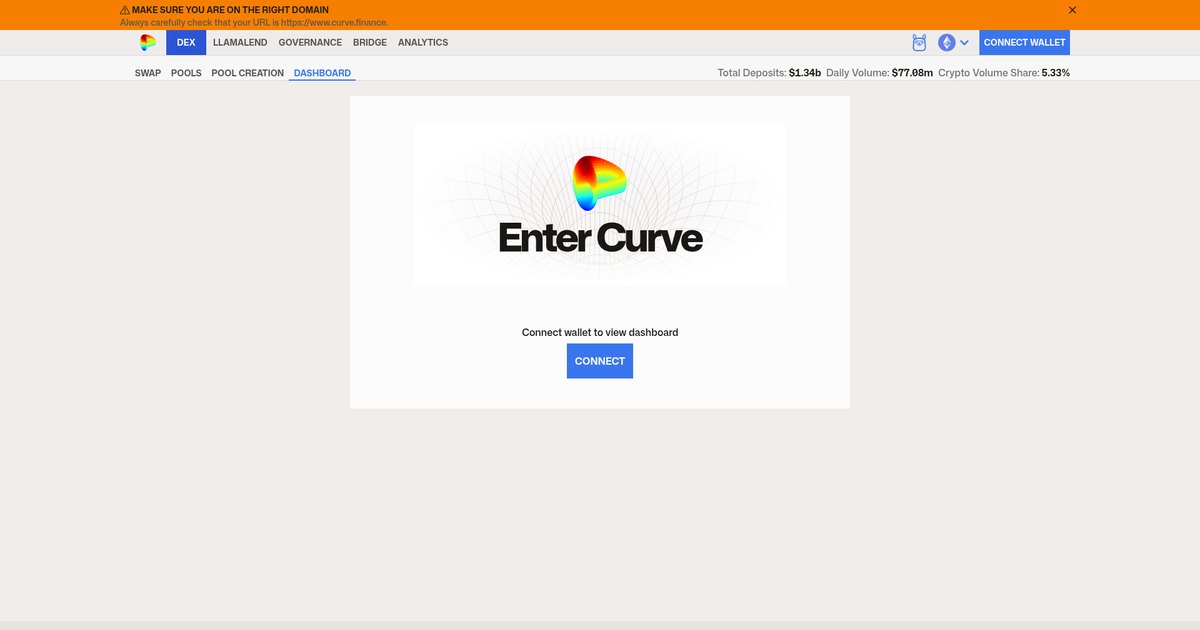
From deposit to reward
Deposit assets into a pool and you receive an LP token. Stake that LP token in the pool's gauge and CRV begins to accrue. Without the second step you earn trading fees only — a common and expensive mistake.
Rewards are claimed manually. Because each claim costs gas, small positions on mainnet can spend more on claiming than they earn; L2 deployments are usually the better home for smaller capital.
How the boost is calculated
Base rewards start at 1×. Holding veCRV raises your multiplier up to 2.5×, based on your veCRV balance relative to your share of the pool and the pool's total liquidity. Adding liquidity without adding veCRV dilutes your own boost.
This is why aggregators exist. Depositing through a protocol that already holds a large veCRV position gives you a share of its boost immediately, minus a performance fee, and without a four-year lock.
Turning APR into realistic net yield
Take the advertised APR, subtract expected gas for deposit, claims and exit, subtract any aggregator performance fee, and haircut the emissions component for the chance that gauge weight falls. What remains is your realistic expectation.
Then decide about compounding: reinvesting rewards raises APY, but only when the position is large enough that the extra transactions pay for themselves.
Tax and record keeping
Reward claims, swaps and withdrawals are usually separate taxable events in most jurisdictions. Export transaction history as you go rather than reconstructing it a year later, and consult a local professional — nothing on this site is tax advice.
Frequently asked questions
Should I farm directly or through an aggregator?
Direct farming with a maximum lock suits large, long-horizon positions. Everyone else usually nets more through an aggregator despite its fee.
Latest updates
Deeper coverage of CRV tokenomics and the Curve wars
Emissions, gauge weights, bribe markets and the role of Convex are described in more detail, together with what locking CRV for four years actually returns to a liquidity provider.
Popular searches answered on this page
What is Curve yield farming and what APY can you expect?
Curve yield farming means supplying a pool, staking the LP token in a gauge and collecting trading fees plus CRV emissions and any external incentives. APY is variable and depends on pool volume, gauge weight and your boost.
Yield farming on Curve →What is Convex Finance and why do people use CVX?
Convex Finance lets liquidity providers get a boosted CRV yield without locking CRV themselves, by pooling veCRV voting power. In exchange, CVX holders direct that voting power, which is a central mechanic of the Curve wars.
Boosts and Convex →Related reading
Articles
How the Curve AMM actually works
A step-by-step explanation of the Curve stableswap invariant, the amplification parameter A, price impact and how cryptoswap extends it to volatile assets.
Read more →
Articles
How to evaluate a stablecoin liquidity pool
A practical checklist for judging a Curve stablecoin pool: asset quality, pool balance, amplification, volume-to-TVL ratio and reward sustainability.
Read more →
Articles
veCRV and how Curve is governed
How the Curve DAO works: veCRV voting weight, proposal thresholds, weekly gauge weight votes, the vote incentive market and its criticisms.
Read more →
Articles
Curve security and the risks that matter
An honest overview of Curve risks: smart contract and compiler bugs, depegs, oracle manipulation, governance capture, phishing, and practical mitigations.
Read more →Guides
What is Curve Finance?
A clear introduction to Curve Finance: the stableswap AMM, who uses it, what problem it solves and how it differs from Uniswap.
Read more →Guides
Curve pools and swaps
How Curve liquidity pools work: pool types, swap fees, slippage, LP tokens, depositing and withdrawing, and how to read pool balance.
Read more →