How the Curve AMM actually works
The stableswap invariant is the heart of Curve. You do not need heavy mathematics to understand it — only the idea that the curve can be tuned between two familiar extremes.
Two curves in one
A constant-sum market (x+y=k) offers zero slippage but can be completely emptied of one asset at a fixed price. A constant-product market (x·y=k) can never be emptied but charges slippage on every trade. Neither is right on its own.
Stableswap interpolates between them. Near the balance point the invariant behaves like constant-sum; as the pool becomes lopsided it smoothly becomes constant-product. Traders get near-zero slippage in normal conditions and the pool keeps a reserve when conditions are not normal.
The amplification parameter
A single parameter, A, controls where the transition happens. High A means a flatter curve, better rates and higher capital efficiency — but a pool that is drained faster when one asset loses its peg. Low A behaves more like Uniswap: worse rates, more protection.
Governance tunes A per pool, and it can be ramped gradually. When evaluating a pool, A tells you as much about its risk appetite as its asset list does.
Cryptoswap for volatile pairs
Cryptoswap (Curve v2) applies the same idea to assets with no fixed relationship. It maintains an internal exponentially-weighted price oracle and repegs the concentrated region of liquidity around it, funded by accumulated fees so that repegging is only performed when profitable.
That yields concentrated-liquidity efficiency without the LP having to manage ranges manually, at the cost of a more complex contract and a dynamic fee that widens during volatility.
Reading price impact in practice
Before a large swap, always compare the quoted output with the ideal 1:1 output. On a healthy pool with high A, a seven-figure stablecoin trade should lose only a few basis points. If it does not, the pool is already imbalanced or too shallow — split the order or route elsewhere.
Frequently asked questions
Does a higher A always mean better rates?
Only while the pool is balanced and every asset holds its peg. Under stress, high A means the pool absorbs the failing asset faster.
Latest updates
FAQ blocks built around real search queries
Fourteen questions per language now answer the things people actually search for: how StableSwap works, what vote-escrow gives you, how LLAMMA soft-liquidation behaves, and whether Curve is safe to use.
crvUSD and lending guide expanded
The crvUSD section now explains the LLAMMA band mechanism, soft liquidation, the borrow rate policy and how peg keepers defend the price, with worked examples of a loan going underwater.
Popular searches answered on this page
How does the Curve AMM and the StableSwap invariant work?
The StableSwap invariant blends a constant-sum and a constant-product curve, staying almost flat near the peg and bending outward when a pool becomes imbalanced. The amplification coefficient A controls how flat that region is.
How the Curve AMM works →Why does Curve have such low slippage on large stablecoin trades?
Because liquidity is mathematically concentrated where the assets trade one-to-one, large size barely moves the price until reserves become imbalanced. That is why Curve routes most of DeFi's stablecoin swap volume.
Read the AMM breakdown →Related reading
Articles
How to evaluate a stablecoin liquidity pool
A practical checklist for judging a Curve stablecoin pool: asset quality, pool balance, amplification, volume-to-TVL ratio and reward sustainability.
Read more →
Articles
Yield farming on Curve, step by step
How CRV rewards are earned and claimed: gauge staking, boost calculation, aggregators like Convex, compounding, gas costs and calculating a realistic net yield.
Read more →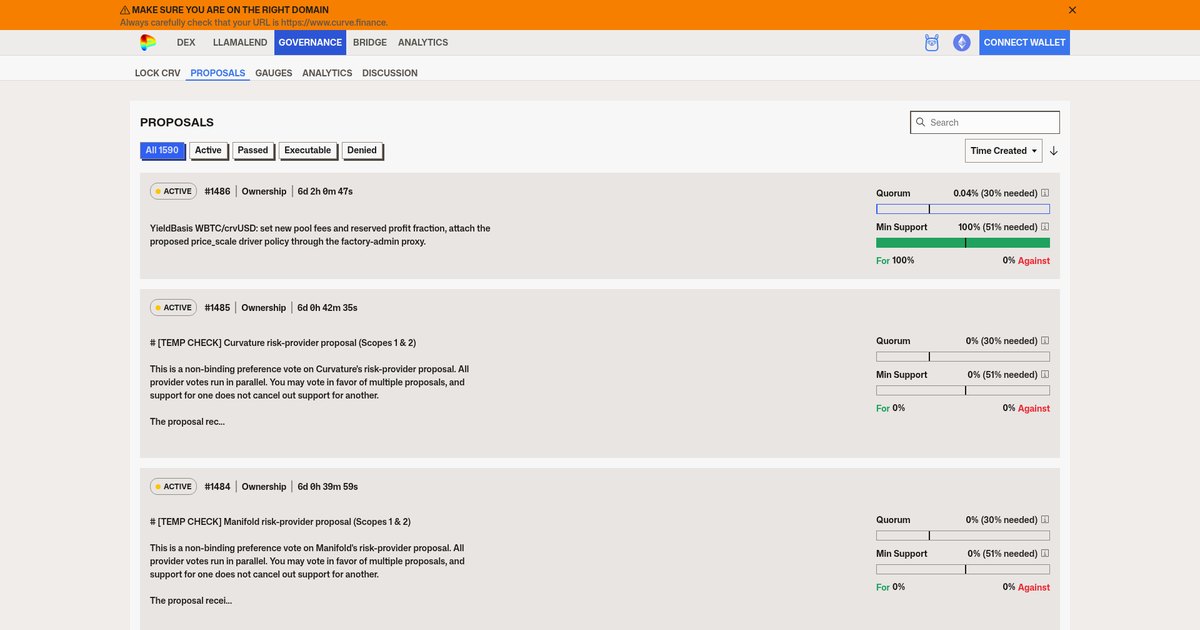
Articles
veCRV and how Curve is governed
How the Curve DAO works: veCRV voting weight, proposal thresholds, weekly gauge weight votes, the vote incentive market and its criticisms.
Read more →
Articles
Curve security and the risks that matter
An honest overview of Curve risks: smart contract and compiler bugs, depegs, oracle manipulation, governance capture, phishing, and practical mitigations.
Read more →Guides
What is Curve Finance?
A clear introduction to Curve Finance: the stableswap AMM, who uses it, what problem it solves and how it differs from Uniswap.
Read more →Guides
Curve pools and swaps
How Curve liquidity pools work: pool types, swap fees, slippage, LP tokens, depositing and withdrawing, and how to read pool balance.
Read more →